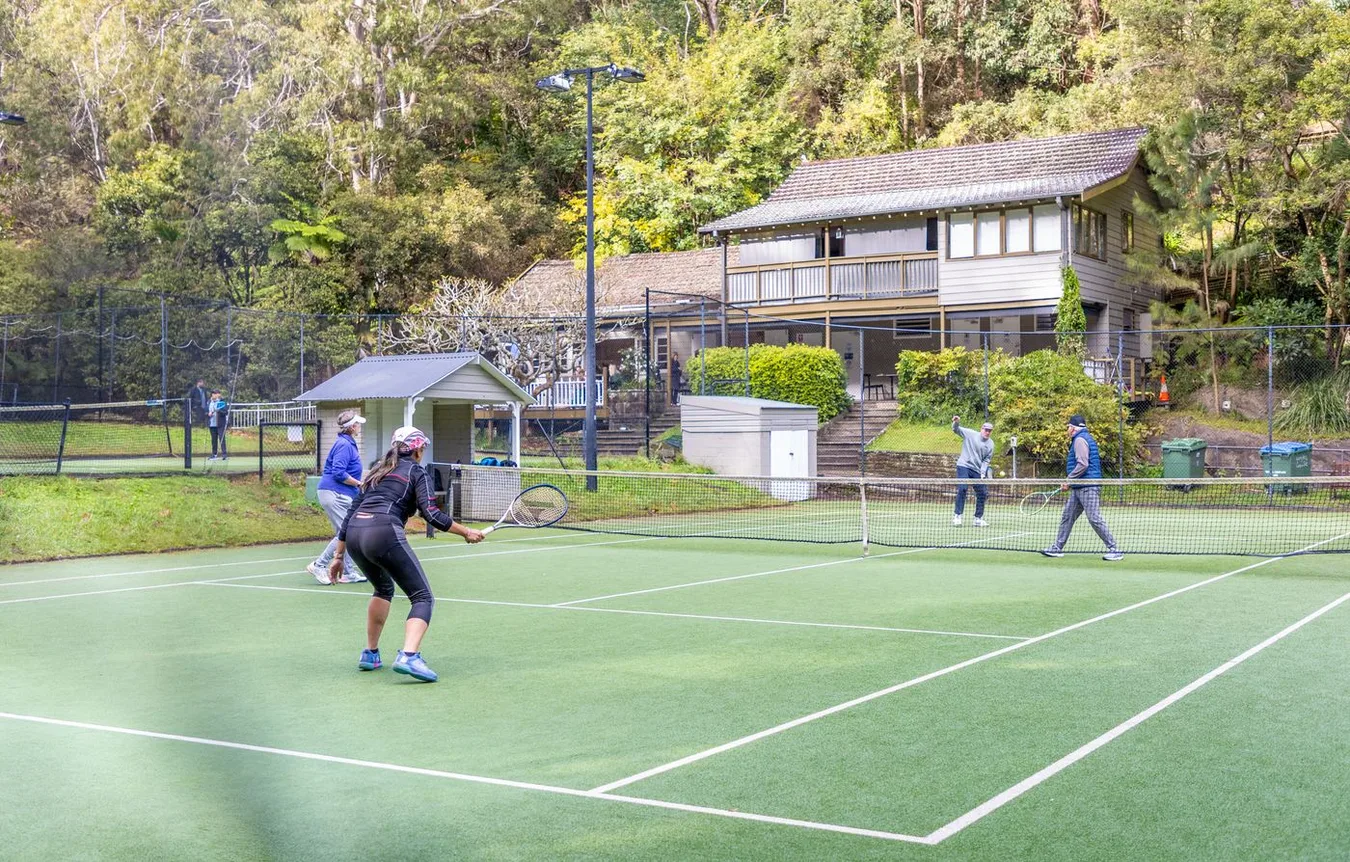
A player at the service line turns to see whether the next ball is passing. Their partner stands behind them and a little toward the middle. From the deeper position the important part of the opponent's movement is hidden behind a familiar shoulder. The ball becomes visible only after it has come a little closer. The first player's position looked appropriate on a chart. In this pair, the starting alignment gives one player less time to act than it should.
Put the same two players in familiar positions during a quiet exercise. A third person across the net can hold a ball where a likely shot might be struck. Ask each partner what part of that position they can actually see. The person nearer the net may assume that both have a completely understandable view. A lateral adjustment or a little change of depth can make the contact available from behind while preserving their original role. The change can be as small as a comfortable standing step.
Learn what the front player reveals with movement
Have the front partner make a small move toward a suitable first ball. The deeper player should be able to recognize where they are about to go and which direction remains available. If the deeper person sees only the back of their partner until they arrive in the way, the movement is informative too late. Try the same starts just a little farther apart, then repeat at a different depth. A long reach for the front player is a different event from a small step. Both should become readable at a practical distance.
Bring the opponent's normal contact into the test. A player in the center of the opposite side can use areas on either side of the front player. From a wide position the visible route can narrow. The deeper person might need to take a different initial stance at a time when the front person has plenty of space. The two can decide which one has the easier adjustment instead of both trying to solve the same hidden view. Ask what the adjustment would leave open in the rest of the court.
Compare settled and recovering positions
An exercise beginning from marks makes it easy to choose a clean view. During play the nearer person may be recovering from a volley and the partner may be stepping across a gap. Run a ball that moves the pair and stop just before the opponent strikes. Ask whether they now share enough of a view to decide whose movement follows. Change one player's path after the prior stroke, then see whether the clearer position appears naturally. A coach's starting mark or a spare ball should stay outside active foot paths. Use features of the court to keep the comparison easy to reproduce.
A good view is part of a good position. It cannot substitute for the reach that a short reply needs. If clearing a sightline takes the front player away from every useful volley, experiment with the deeper partner's route instead. Look for an offset that permits a useful stroke and a response to the other player's movement. A clean view obtained from an unusable spot is only evidence about a single part of the problem.
Play through the first surprise
Start a handful of normal points from the adjusted arrangement. Watch for a reply that turns out to be more direct than the usual diagonal one. The deeper player should now be able to see where it starts. The nearer partner should recognize when a move will expose or cover something the other one can use. If something still blocks either view, describe the time and place after the point and test another modest offset.
Use that shared picture when a different opponent starts sending the ball from a different position. The pair can step or hold with a clear reason. Each player can see enough of the shot and the partner's movement to choose their own first response, which prepares the next contact without asking either person to leave their ordinary place entirely.